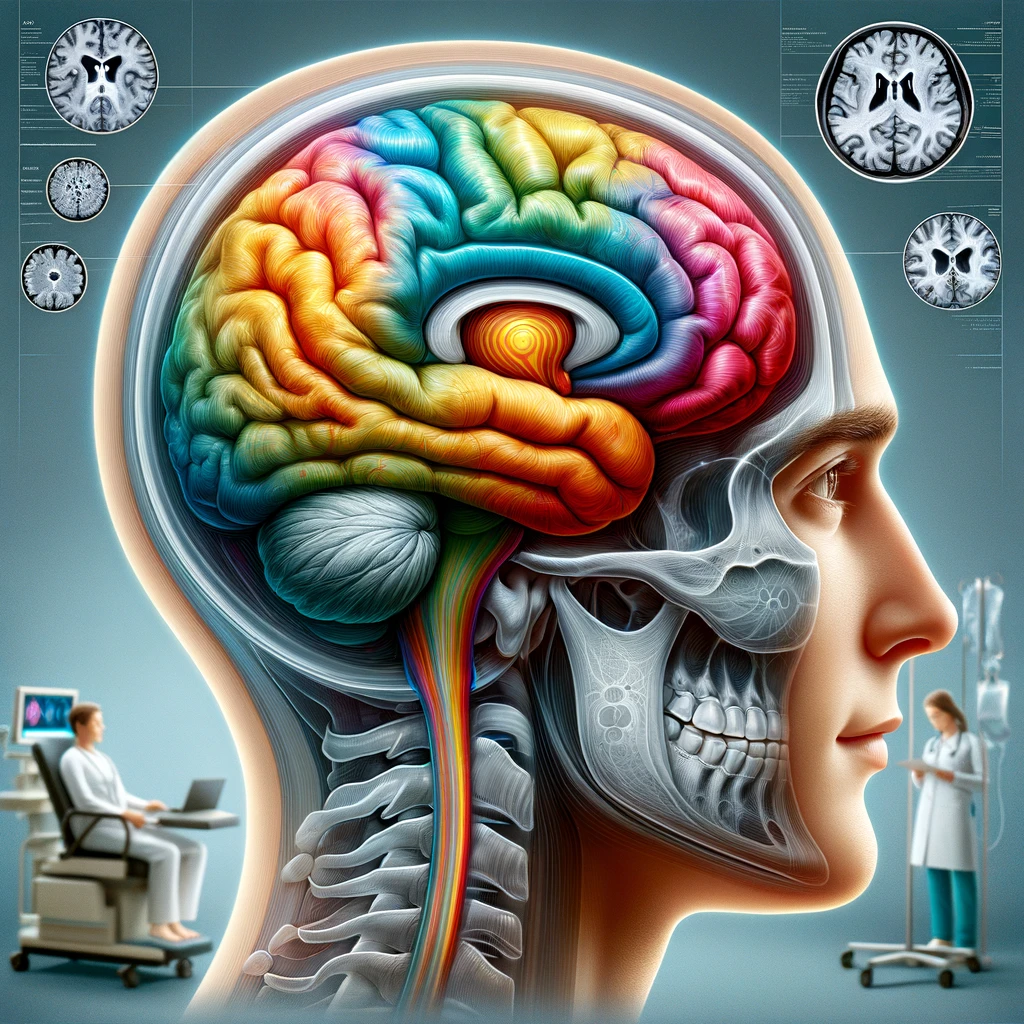

When Time Stops Flowing Forward
Recent quantum experiments have revealed something astonishing: when one entangled particle is measured, its twin behaves as if it already knew the outcome. This phenomenon — quantum retrocausality — suggests that information may flow not just from past → future, but also from future → past.
If time is not strictly linear, but bidirectional, then the brain — our most advanced prediction system — may also operate across this two-way temporal structure.
This raises a radical but coherent possibility: the brain may integrate information not only from the past, but also from counterfactual futures — events that almost happened but never did.
The Bayesian Brain: A Predictive Engine
Modern neuroscience describes the brain as a Bayesian inference system:
P(Brain State | Sensory Input) = P(Brain State) × P(Sensory Input | Brain State)
The brain:
- builds priors from past experiences
- compares them with sensory input
- updates its internal model to minimise prediction error
Karl Friston’s Free Energy Principle formalises this:
Brain’s Goal → Minimise Free Energy → Minimise Surprise
The brain constantly attempts to reduce this free energy, keeping internal expectations aligned with reality.
But what if the brain is using more than just the past?
What If the Brain Also Samples the Future?
If the universe is temporally symmetric:
- the brain may update its priors based not only on historical data
- but also on near-miss futures (events that would have occurred without small corrective actions)
This is not mysticism — it is a logical extension of temporally bidirectional physics and the brain’s predictive nature.
Imagine someone nearly slips but catches themselves instantly. Consciously, they are unaware of the “almost fall.” But computationally, the brain may register:
“Had I not corrected myself, I would have fallen.”\text{“Had I not corrected myself, I would have fallen.”}“Had I not corrected myself, I would have fallen.”
The Bayesian system then updates its priors as if the near-fall were real.
This is over-updating, not under-updating.
The Brain as an Overfitting Machine
In machine learning, overfitting happens when a model:
- learns the noise in the data
- incorporates rare anomalies
- becomes too precise
- loses generalisation
Exactly the same can happen in the brain.
Instead of failing to update priors (the traditional FND model), the brain overcorrects them.
A Simple Mathematical Illustration
Normal Bayesian updating:
New Prior = Old Prior + k × Prediction Error
(where k is a small learning rate)
In FND:
New Prior = Old Prior + K × Prediction Error(where K ≫ k, meaning the update is far too strong)

The brain overweights the prediction error — especially if it arises from a counterfactual future event.
This produces:
- excessively sharp priors
- overly precise beliefs
- maladaptive predictions
Why Neural Plasticity Matters
Normally, plasticity prevents overfitting:
- weak evidence is discarded
- rare events have low weight
- anomalous futures are ignored
But in FND:
- plasticity is noisy, impaired, or unstable
- the brain cannot relax its overfitted priors
- the model becomes trapped in a rigid attractor state
This produces persistent symptoms such as:
- functional weakness
- abnormal movement patterns
- gait disorders
- non-epileptic attacks
- sensory loss
- dissociation
Even though the hardware — the nervous system — is intact.
FND as a Disorder of Temporal Overfitting
FND is not a failure of updating priors. It is an overcorrection of priors.
Specifically:
- The brain incorporates counterfactual futures as real evidence.
- Priors become excessively precise (overfitting).
- Impaired plasticity prevents recalibration.
- Symptoms emerge as the brain’s best attempt to reconcile the overfitted model with sensory reality.